AI
Scientific Blog
News
Artificial Intelligence for biological image Analysis: Accelerating discovery in the lab
Oct 13, 2025
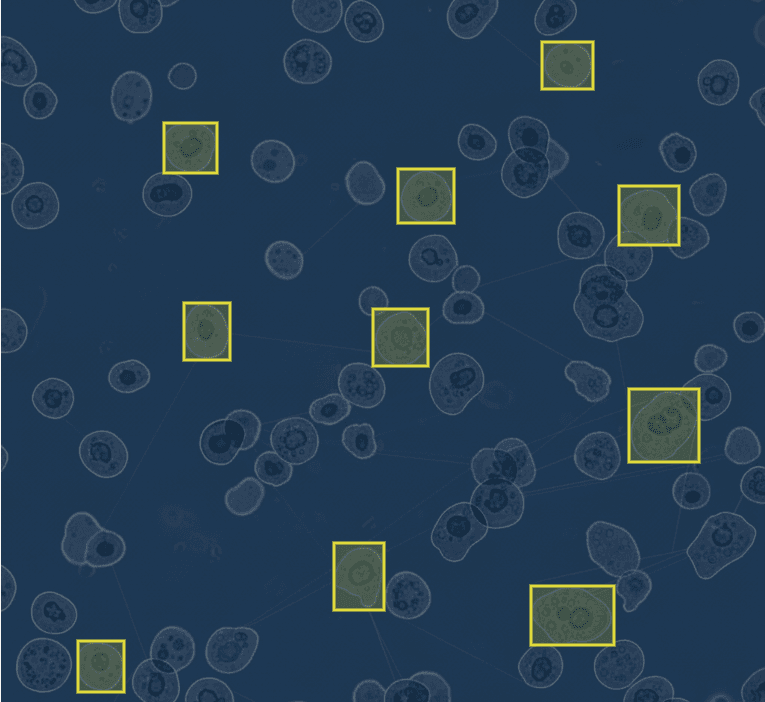
Artificial Intelligence for Biological Image Analysis: Accelerating Discovery in the Lab
The Growing Need for Image Analysis
Modern biological research generates massive amounts of imaging data, from cellular microscopy and tissue imaging to plant and animal studies.
These images contain essential information about:
🔬 Cell morphology and physiology
🧩 Protein-protein interactions
⏱️ Dynamic phenomena such as cell division or intracellular trafficking
However, manual analysis is time-consuming, labor-intensive, and prone to error, limiting researchers’ ability to fully exploit their data.
Objective of BionomeeX
BionomeeX develops AI tools to automate and accelerate the analysis of biological images while maintaining human oversight for accuracy.
The objectives are:
Automatically extract quantitative and qualitative information from complex images
Allow researchers to focus on scientific interpretation and hypothesis generation
Methodology: Human-in-the-Loop for Imaging
The methodology is based on a Human-in-the-Loop approach:
✍️ Initial annotations: Researchers annotate a small subset of images to identify cells, organelles, or proteins
🤖 AI model training: Annotations train deep learning models to predict labels across the entire dataset
✅ Human validation: Predictions are verified and corrected by experts to improve precision and reliability
🔄 Iteration: Models are retrained on validated annotations, progressively enhancing performance
This approach converts hundreds or thousands of images into actionable data, while significantly reducing analysis time.
Concrete Applications
BionomeeX tools have been successfully applied to:
🧬 Track cell cycle progression in various cell types
🧪 Identify and quantify protein-protein interactions from microscopy images
⚡ Assess cell health and physiological states, detecting anomalies or cellular stress
📊 Generate high-quality annotated datasets for training predictive models
Results and Advantages
The combination of AI and human validation reduces analysis time by 5–10× compared to manual processing.
Models achieve high precision, correctly identifying the majority of annotated cells and structures
The iterative approach allows models to continuously improve as the dataset expands
Perspectives
AI-driven biological image analysis opens up new possibilities:
Study cellular behavior in real time
Monitor complex population dynamics
Integrate imaging with other data types, such as genomics and transcriptomics, for a comprehensive view of biological systems
BionomeeX continues to develop these tools to support researchers at every stage of image analysis, from data collection to scientific interpretation.
Genomic Insights: Understanding Biological Traits and Diseases
In addition to image analysis, BionomeeX provides genomic analysis tools to explore:
Genetic variation, polymorphisms, and phenotypic traits
Linking genotype to phenotype, revealing how genetic variations influence observable traits
Detecting potential markers for diseases, supporting studies in pathology and health research
These tools complement AI-driven image analysis, helping scientists uncover the genetic basis of complex traits and diseases.