The world’s first interdisciplinary 2D epistatic interaction map powered by AI.
The world’s first interdisciplinary 2D
epistatic interaction map powered by AI.
Next Gen GWAS Revealing the Future Hidden in Your Genome
Next Gen GWAS Revealing the Future Hidden in Your Genome
GWAS 2D
GWAS 2D
GWAS 2D
NEW GWAS TECHNOLOGY
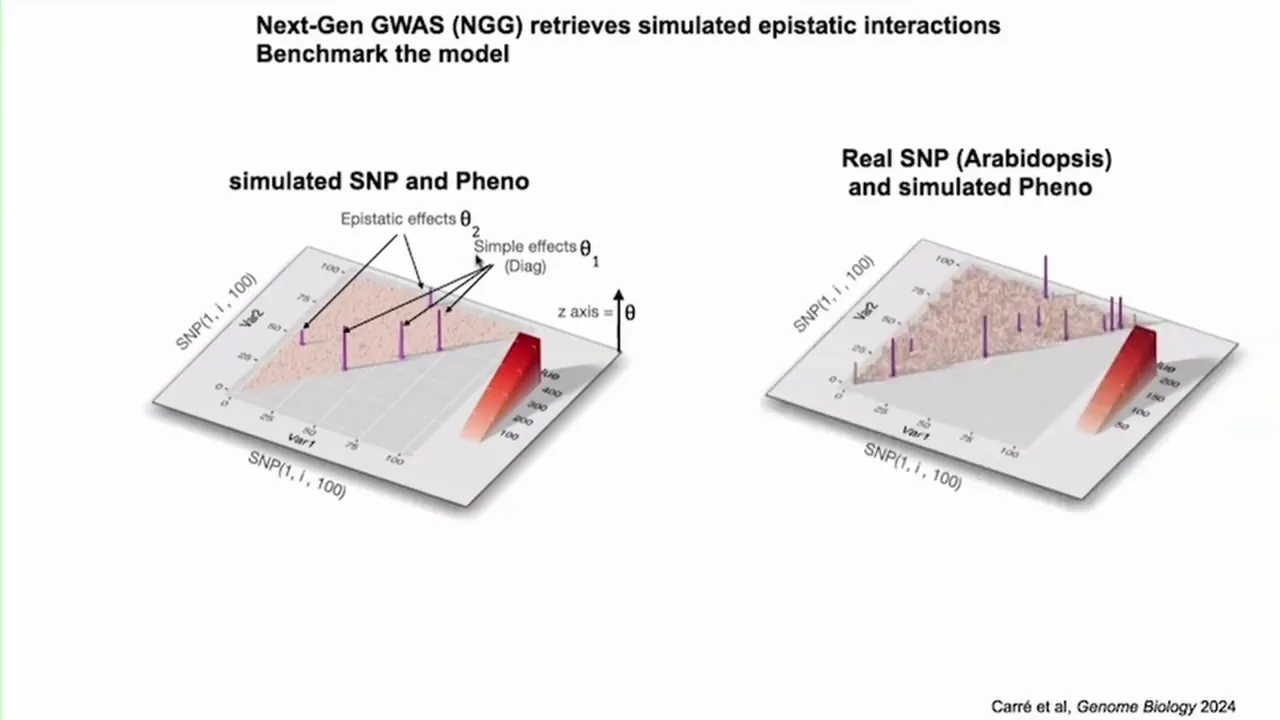
We have recently developed a new GWAS technology. This method represents the first complete 2D epistatic interaction map to date.
Our 2D GWAS is reshaping systems biology and molecular genetics by mapping millions of 2D interactions, revealing missing heritability, and predicting disease risk in humans, plants, and animals.
benefice 1
Detection of Epistatic Interactions – Identifies how pairs of SNPs interact to influence traits or disease risk.
benefice 2
benefice 3
benefice 4
Benefits of 2-SNP
(2D) Analysis :
Mapping Genetic
Interactions
Updates and discoveries in bioinformatics and data analysis.
Newsletter GWAS
Benefits of 2-SNP
(2D) Analysis :
Mapping Genetic Interactions
benefice 1
Detection of Epistatic Interactions – Identifies how pairs of SNPs interact to influence traits or disease risk.
benefice 2
Improved Heritability Estimates – Captures part of the missing heritability not explained by single-SNP analyses.
benefice 3
Enhanced Phenotype Prediction – Provides more accurate predictions of traits, diseases, or responses.
benefice 4
Comprehensive Data Exploration – Enables the study of millions of SNP pairs, revealing complex genetic patterns.
Updates and discoveries in bioinformatics and data analysis.
Newsletter GWAS
Scientific & strategic partnerships








NEW GWAS TECHNOLOGY
NEW GWAS TECHNOLOGY
We have recently developed a new GWAS technology. This method represents the first complete 2D epistatic interaction map to date.
We have recently developed a new GWAS technology.
This method represents the first complete 2D epistatic interaction map to date.
Our 2D GWAS is reshaping systems biology and molecular genetics by mapping millions of 2D interactions, revealing missing heritability, and predicting disease risk in humans, plants, and animals.
Our 2D GWAS is reshaping systems biology and molecular genetics by mapping millions of 2D interactions, revealing missing heritability, and predicting disease risk in humans, plants, and animals.

benefice 1
Detection of Epistatic Interactions – Identifies how pairs of SNPs interact to influence traits or disease risk.
benefice 2
Improved Heritability Estimates – Captures part of the missing heritability not explained by single-SNP analyses.
Benefits of 2-SNP
(2D) Analysis :
Mapping Genetic Interactions
benefice 3
Enhanced Phenotype Prediction – Provides more accurate predictions of traits, diseases, or responses.
benefice 4
Comprehensive Data Exploration – Enables the study of millions of SNP pairs, revealing complex genetic patterns.
Updates and discoveries in bioinformatics and data analysis.
Newsletter GWAS
Scientific & strategic partnerships


More details about GWAS2D
More details about GWAS2D
More details about GWAS2D
Scientific & strategic partnerships


Next Gen GWAS: Advancing Medicine,
Genetic Variant Identification, and Plant Genomics
Plant
breeding
Next Gen GWAS enables faster and more precise crop improvement by uncovering complex genetic
interactions that control traits such as yield, resistance, and adaptation.
Pharmaceutical
Industry
Revealing complex genetic interactions helps identify therapeutic targets, predict patient responses, and design more efficient clinical trials.
Marker
identification
Next Gen GWAS identifies genetic markers and their interactions across the genome. Unlike traditional GWAS, NGG maps single-gene and epistatic effects in 2D, revealing complex disease pathways.
Plant
breedingNext Gen GWAS enables faster and more precise crop improvement by uncovering complex genetic
interactions that control traits such as yield, resistance, and adaptation.
Pharmaceutical
IndustryRevealing complex genetic interactions helps identify therapeutic targets, predict patient responses, and design more efficient clinical trials.
Marker
identificationNext Gen GWAS identifies genetic markers and their interactions across the genome. Unlike traditional GWAS, NGG maps single-gene and epistatic effects in 2D, revealing complex disease pathways.
Plant
breedingNext Gen GWAS enables faster and more precise crop improvement by uncovering complex genetic
interactions that control traits such as yield, resistance, and adaptation.
Pharmaceutical
IndustryRevealing complex genetic interactions helps identify therapeutic targets, predict patient responses, and design more efficient clinical trials.
Marker
identificationNext Gen GWAS identifies genetic markers and their interactions across the genome. Unlike traditional GWAS, NGG maps single-gene and epistatic effects in 2D, revealing complex disease pathways.
Plant
breedingNext Gen GWAS enables faster and more precise crop improvement by uncovering complex genetic
interactions that control traits such as yield, resistance, and adaptation.
Pharmaceutical
IndustryRevealing complex genetic interactions helps identify therapeutic targets, predict patient responses, and design more efficient clinical trials.
Marker
identificationNext Gen GWAS identifies genetic markers and their interactions across the genome. Unlike traditional GWAS, NGG maps single-gene and epistatic effects in 2D, revealing complex disease pathways.
What is GWAS ?
GWAS (Genome-Wide Association Study) is a life-science research method used to identify
genetic variants linked to specific traits or diseases.
Next Gen GWAS: Advancing Medicine, Genetic Variant Identification, and Plant Genomics
Next Gen GWAS: Advancing Medicine, Genetic Variant Identification, and Plant Genomics
Plant
breeding

Next Gen GWAS enables faster and more precise crop improvement by uncovering complex genetic interactions that control traits such as yield, resistance, and adaptation.
Plant
breeding

Next Gen GWAS enables faster and more precise crop improvement by uncovering complex genetic
interactions that control traits such
as yield, resistance, and adaptation.
Marker
identification
Next Gen GWAS identifies genetic markers and their interactions across the genome. Unlike traditional GWAS, NGG maps single-gene and epistatic effects in 2D, revealing complex
disease pathways.
Marker
identification
Next Gen GWAS identifies genetic markers and their interactions across the genome. Unlike traditional GWAS, NGG maps single-gene and epistatic effects in 2D, revealing complex
disease pathways.
Pharmaceutical
industry
Revealing complex genetic interactions helps identify therapeutic targets, predict patient responses, and design more efficient clinical trials.
Pharmaceutical
Industry
Revealing complex genetic interactions helps identify therapeutic targets, predict patient responses, and design more efficient clinical trials.
What is Gwas ?
GWAS (Genome-Wide Association Study) is a life-science research method used to identify
genetic variants linked to specific traits or diseases.
What is Gwas ?
GWAS (Genome-Wide Association Study) is a life-science research method
used to identify genetic variants linked to specific traits or diseases.
Compare editions
Compare editions
Compare editions
GWAS
GWAS 2D
Traditional GWAS (1D)
Feature / Capability
Single-SNP analysis

Pairwise SNP reactions
—
Captures non-additive
effects
—
Large-scale analysis
(more than 80 billions of SNPs)
—
Fast computation
—
Enhanced phenotypic
prediction
—
Interactive visualization
—
Applicable to multiple species
(human, plant, animal)
Customizable to dataset
—
GWAS
GWAS 2D
Traditional GWAS (1D)
Feature / Capability
Single-SNP analysis
Pairwise SNP reactions
—
Captures non-additive
effects
—
Large-scale analysis
(more than 80 billions of SNPs)
—
Fast computation
—
Enhanced phenotypic
prediction
—
Interactive visualization
—
Applicable to multiple species
(human, plant, animal)
Customizable to dataset
—
Feature / Capabilty
Single-SNP analysis
Pairwise SNP reactions
Captures non-additive
effects
Large-scale analysis
(more than 80 billions of SNPs)
Fast computation
Enhanced phenotypic
prediction
Interactive visualization
Applicable to multiple species
(human, plant, animal)
Customizable to dataset