Events
AI Pest Detection in Vineyards: SITEVI 2025"

What Bionomeex Demonstrated at SITEVI 2025
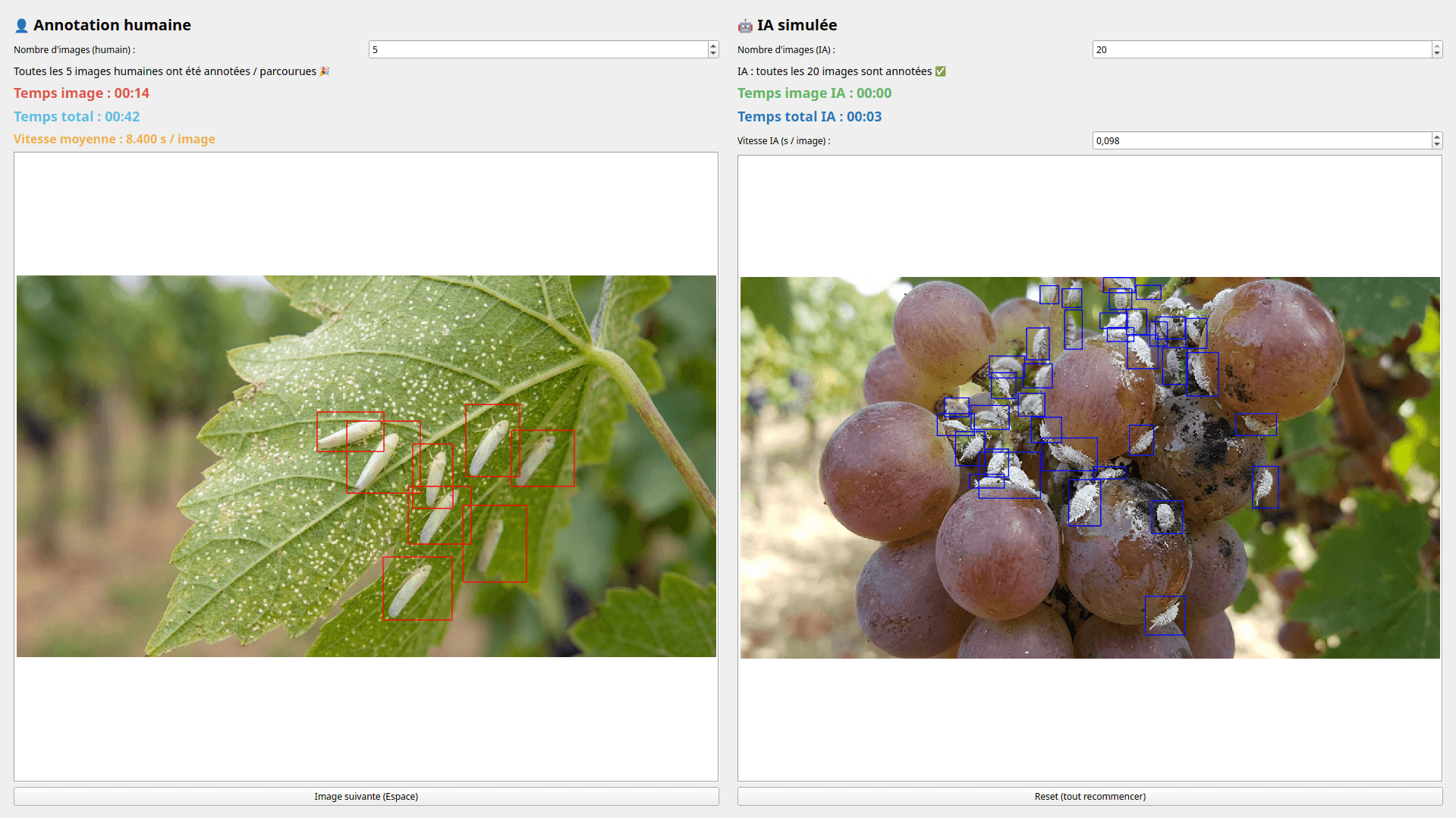
At SITEVI 2025 the leading viticulture and arboriculture trade show held at the Parc des Expositions in Montpellier from 25 to 27 November Bionomeex demonstrated an AI system that detects pest insects on grapevine images in real time. Visitors at the stand annotated vine images by hand, then watched the same task run on four times as many images in a fraction of the time. The numbers from the live demo: 5 images manually annotated in 42 seconds, 8.4 seconds per image. The AI annotated 20 images in 3 seconds, at 0.098 seconds per image.
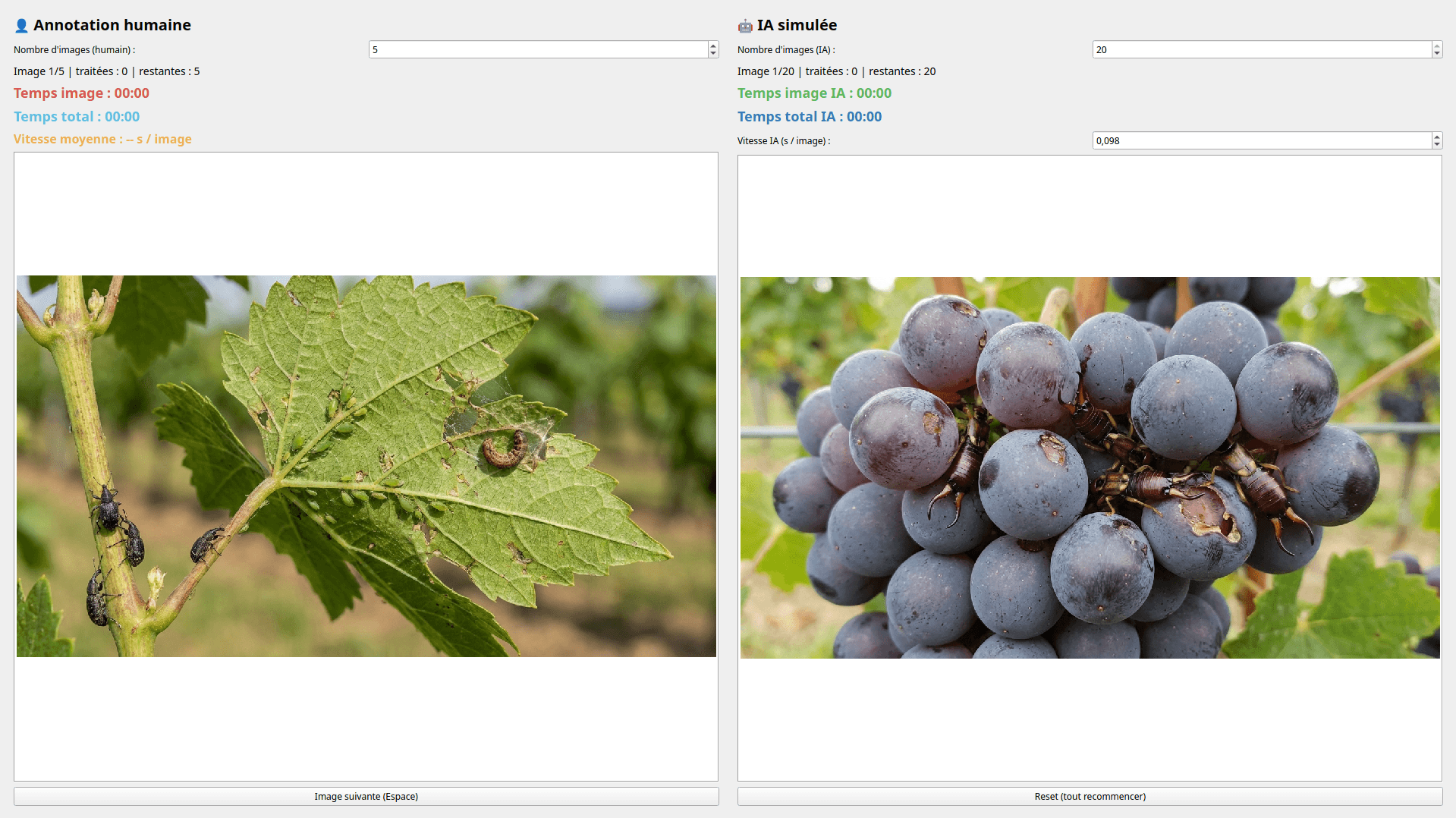
That gap is the core argument for AI pest detection in viticulture. Monitoring a vineyard for insects manually does not scale. The AI does.
What the System Detects
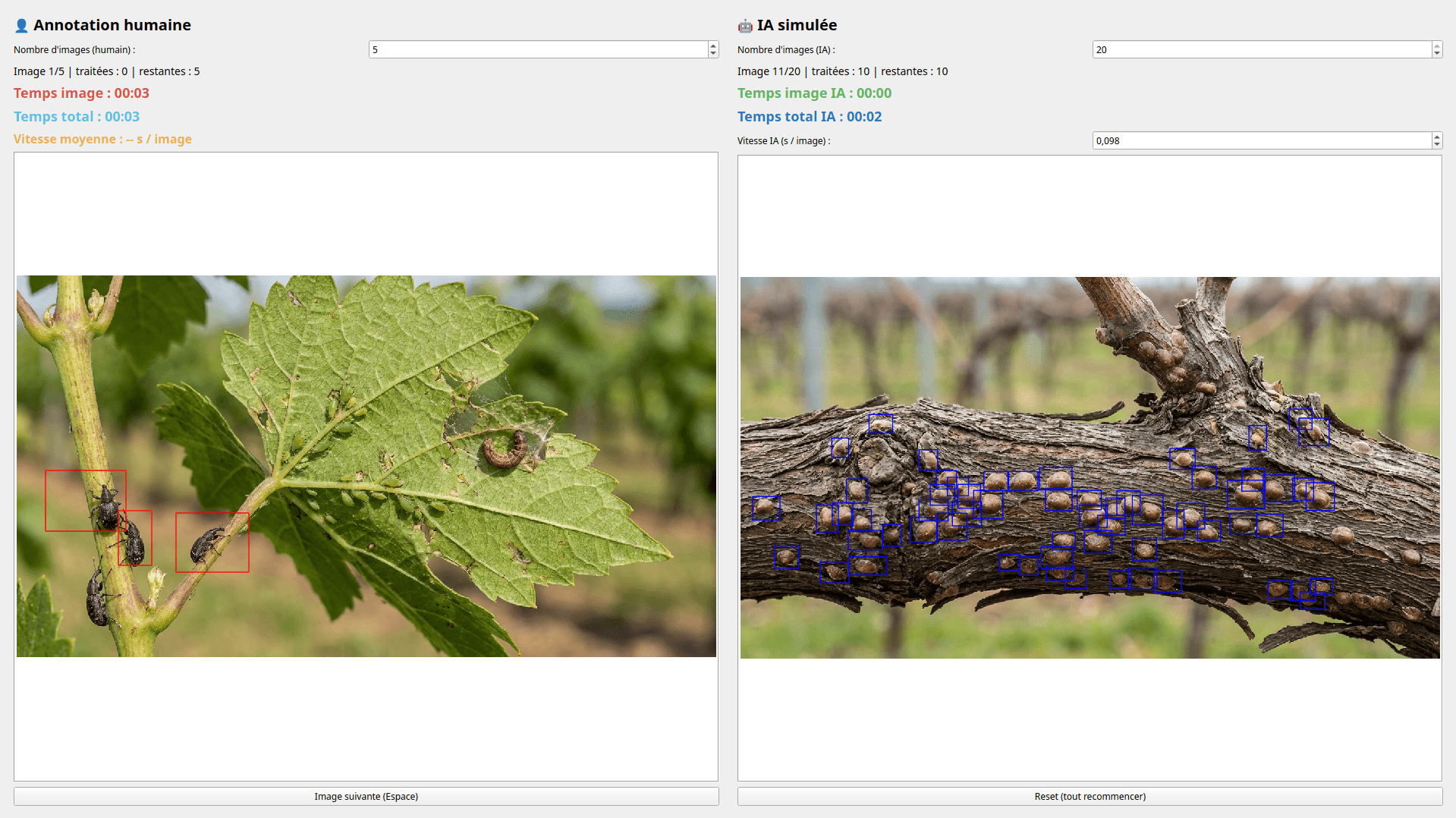
The Bionomeex pest detection system identifies insects on three distinct surfaces across a vine: leaves, grape clusters, and wood.
On leaves, the system detects mealybugs at different life stages including larvae on leaf undersides where early infestations are hardest to spot by eye. On grape clusters, it identifies mealybug colonies in dense aggregations directly on the fruit. On wood, it locates scale insects distributed along vine trunks and cordons a category particularly relevant for early-season monitoring before canopy development obscures the bark.
The system draws bounding boxes around each detected organism, counts them, and returns results across an entire image batch in seconds. A viticulture technician reviewing 20 images manually takes roughly 3 minutes. The AI takes 3 seconds.
How It Works - Computer Vision for Viticulture
The system applies object detection a computer vision technique where a neural network learns to locate and classify objects within images from a set of labeled training examples. Bionomeex trained the model on annotated vine images covering multiple pest species, growth stages, and field conditions.
The interface shown at SITEVI ran two parallel tracks simultaneously: one for the human annotator, one for the AI. The human worked through 5 images. The AI processed 20. By the time the human finished the third image, the AI had annotated all 20 and stopped.
The underlying approach detection, segmentation, and quantification applied to biological imagery is the same computer vision methodology Bionomeex uses across its other life sciences projects, from microscopy image analysis to aerial drone footage for environmental monitoring. Viticulture pest detection is one domain within a broader AI imaging platform built for biological data.
Why Pest Detection Matters for Viticulture
Mealybugs and scale insects are among the most economically damaging pests in viticulture. Mealybugs transmit grapevine leafroll-associated viruses, which reduce yield and alter sugar and acid composition in fruit. Scale insects weaken vines by feeding on sap and produce honeydew that promotes sooty mold growth on wood and clusters.
Early detection changes the economics of pest management. A small infestation treated at the right moment costs a fraction of what a widespread infestation requires. The problem is that early-stage insects are small, cryptic, and distributed across thousands of vine plants. Manual scouting is slow. It relies on skilled observers covering ground on foot. It misses what the eye does not catch or cannot reach.
An AI system running on field photographs taken by a technician with a smartphone covers the same ground faster, more consistently, and with a documented detection record per image. It does not replace agronomic judgment it gives the agronomist better data to act on.
The Bionomeex stand at SITEVI made this concrete. Visitors who tried the annotation interface reported that manual annotation required concentration and still produced inconsistent bounding boxes. The AI returned uniform, reproducible detections across all 20 images in the same time the human needed to annotate 5.
SITEVI 2025 - The Right Event for This Demonstration
SITEVI is held every two years in Montpellier and covers viticulture, arboriculture, and olive growing across the full production chain. The 2025 edition brought together professionals from across France and the Mediterranean basin winegrowers, agronomists, cooperatives, input suppliers, and machinery manufacturers.
Montpellier's role in this ecosystem runs deeper than geography. The region produces appellation wines from Languedoc and Roussillon, and its research institutions - INRAE, CNRS, Institut Agro - run active programs in plant protection, integrated pest management, and vineyard ecology. Presenting an AI pest detection tool at SITEVI in Montpellier connected the technology directly to the practitioners and researchers working on these problems in the field.
The discussions on the stand confirmed the interest. Visitors asked about detection accuracy across different lighting conditions, about integrating the tool into existing scouting protocols, and about the minimum image quality required for reliable detections. These were not abstract questions they came from people who scout vineyards and wanted to know if the system would work in their conditions.
Where This Fits in Bionomeex's Agricultural AI Work
Pest detection in vineyards is one application within a broader agricultural research program at Bionomeex. The ANR-funded NGS-OLICIT project, carried out with CBGP researchers, uses similar AI image analysis to study pest-parasitoid interactions on citrus and olive crops mapping which biological control agents suppress which pest populations under which conditions. The goal there is reducing pesticide use through targeted biological intervention rather than broad-spectrum chemical treatment.
The SITEVI demonstration applied the same detection approach to viticulture, a sector where Montpellier's scientific and professional ecosystem is particularly dense. Vineyards are the dominant agricultural landscape of Occitanie, and pest pressure from insects is one of the leading causes of yield loss and quality degradation across the region.
Bionomeex's position at this intersection computer vision trained on biological data, applied to Mediterranean crops, demonstrated at the sector's leading trade show in Montpellier reflects the company's founding logic: build AI tools that solve hard scientific problems in the ecosystems where those problems are most pressing.
→ AI for Pest and Parasitoid Interaction Analysis — NGS-OLICIT
→ Agritech Montpellier
→ AI Agriculture Montpellier
Frequently Asked Questions
What pests does the Bionomeex system detect in vineyards?
The system demonstrated at SITEVI 2025 detected mealybugs on leaves and grape clusters, and scale insects on vine wood. The model identifies organisms at different life stages and across different vine surfaces, returning bounding boxes and counts per image.
How fast is the AI compared to manual annotation?
In the live demonstration at SITEVI, a human annotator completed 5 images in 42 seconds 8.4 seconds per image. The AI annotated 20 images in 3 seconds at 0.098 seconds per image. The AI processed four times as many images in roughly one-fourteenth of the time.
What image quality does the system require?
The system runs on field photographs taken with a standard smartphone camera. Images must be in focus and at sufficient resolution to distinguish individual insects, but do not require specialized equipment. Lighting conditions and image angle affect detection accuracy this was one of the practical questions visitors raised at SITEVI.
Does this replace manual vine scouting?
No. The system gives agronomists faster, more consistent data from field photographs. The agronomist still makes treatment decisions based on infestation levels, crop stage, and local conditions. AI detection replaces the annotation step, not the agronomic judgment.
Is this tool available for vineyards today?
Bionomeex demonstrated the system as a working prototype at SITEVI 2025. Contact the team directly to discuss deployment in a vineyard context.
CONCLUSION :
The SITEVI demonstration put a specific number on the speed gap between manual and AI pest detection: 8.4 seconds per image versus 0.098 seconds. At vineyard scale, that difference is the gap between a monitoring protocol that works operationally and one that does not.
Bionomeex builds AI for biological imagery. Vineyards, citrus groves, olive orchards, forests the detection problem is the same across all of them. The model changes. The underlying technology does not.